$1.25M Pre-Seed · Closing June 30, 2026
Sovereign Memory
for the Agentic Economy.
Verifiable memory for autonomous AI agents.
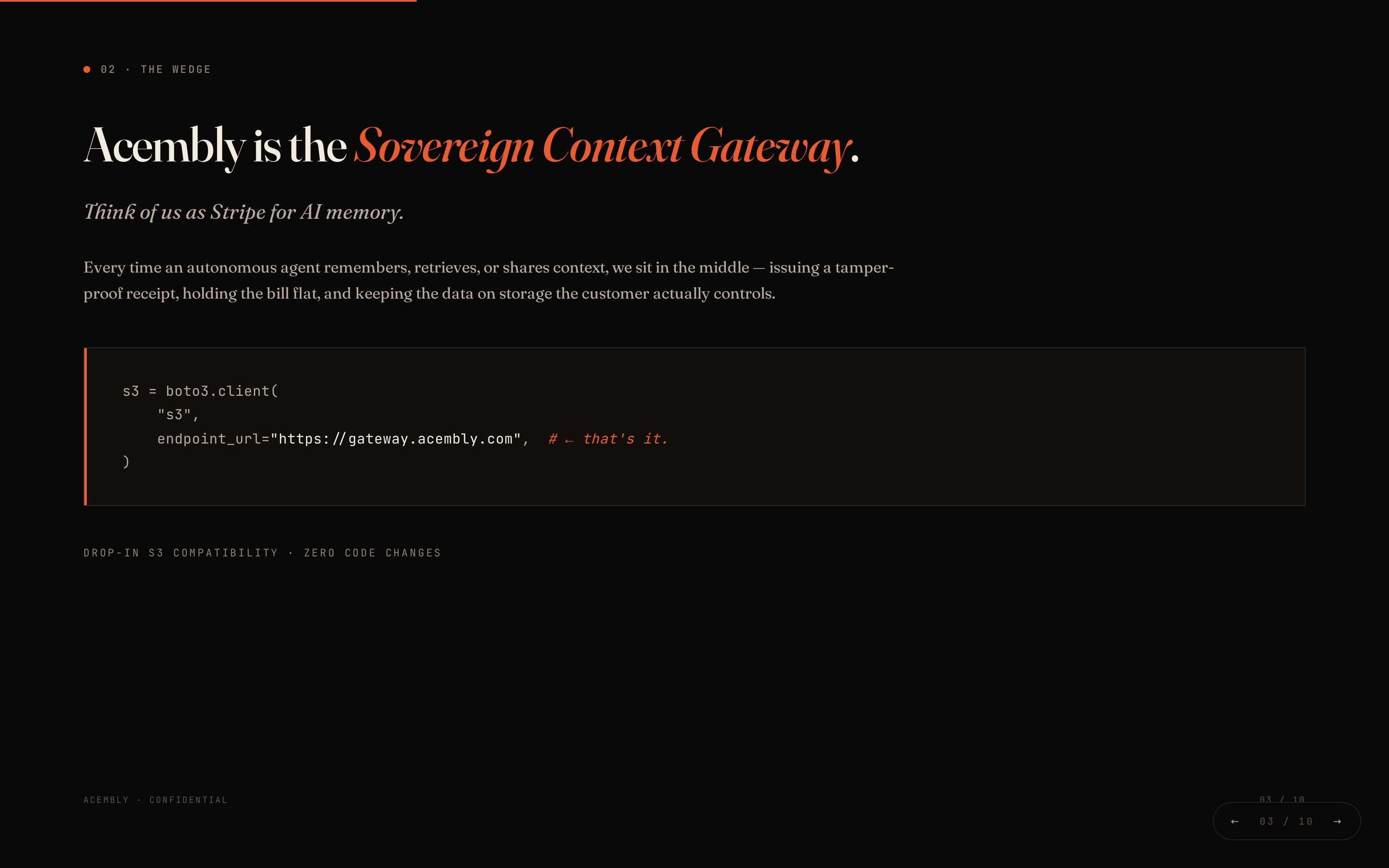
Think of Acembly as Stripe for AI memory. Every time an autonomous agent remembers, retrieves, or shares context, we sit in the middle — issuing a tamper-proof receipt, holding the bill flat, and keeping the data on storage the customer actually controls. One drop-in integration replaces three failing layers of the current AI stack with a single sovereign substrate an enterprise auditor can trust.
The round at a glance
$1.25M to ship paid compliance
the day EU AI Act enforcement begins.
A capital-efficient pre-seed sized exactly to the August 2, 2026 milestone. Day 61 from close lands on EU AI Act enforcement day. We deploy paid Tier 2 compliance logging the morning it activates.
Raise
$1.25M
Structure
SAFE
Tiered post-money cap · MFN included
Closing
June 30, 2026
Day 61
Aug 2, 2026
EU AI Act enforcement begins
The deck
10 slides · 10 minutes.
The full investor deck. Click any slide to view at full size.
Executive summary
The two-minute version.
The Problem
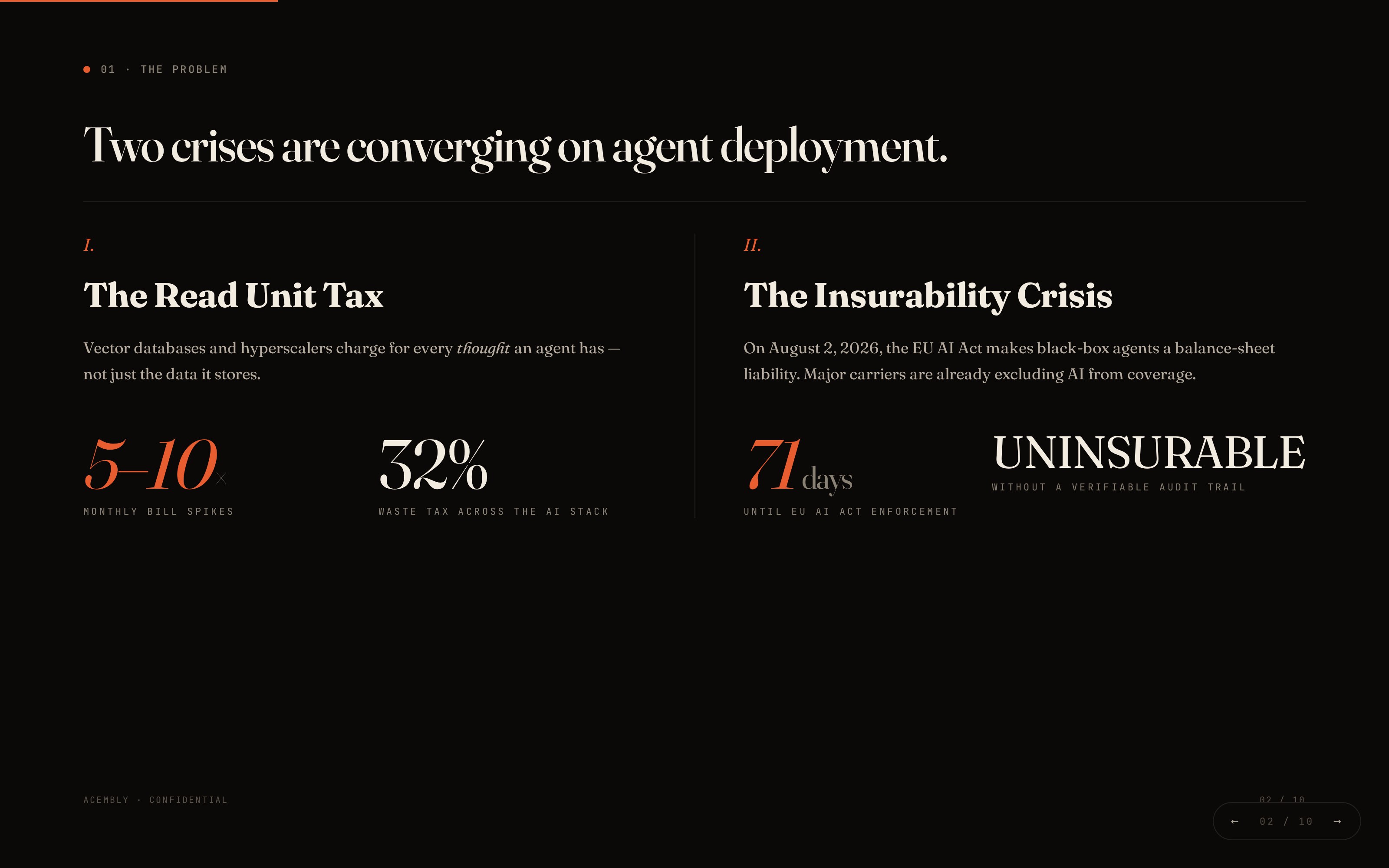
Two crises are converging on agent deployment in 2026. The first is economic — vector databases and hyperscalers charge for every thought an agent has, producing a 32% waste tax and 5–10× monthly bill spikes. The second is existential — on August 2, 2026, the EU AI Act makes black-box agents a balance-sheet liability, and major carriers are already excluding AI from coverage.
Predictable cost. Provable memory. These are not features anymore. They are the floor.
The Solution
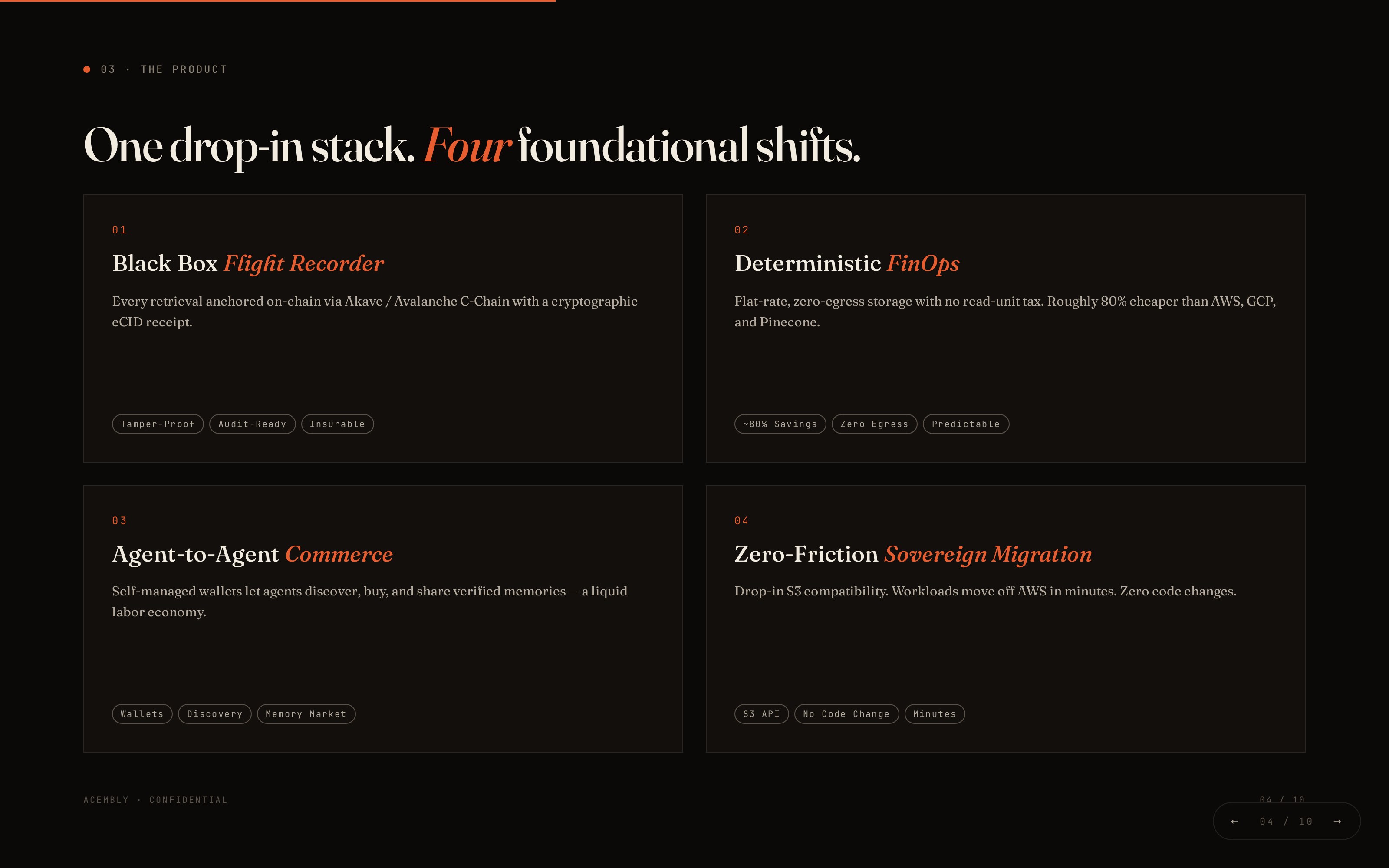
Acembly ships as one drop-in stack built around four foundational shifts:
- Black Box Flight Recorder. Every retrieval produces a tamper-proof cryptographic receipt — an immutable, regulator-ready audit log. The anchoring infrastructure is fully abstracted; enterprises see no wallets, no tokens, no chain mechanics.
- Deterministic FinOps. Flat-rate, zero-egress storage with no read-unit tax. Roughly 80% cheaper than AWS, GCP, and Pinecone — and a bill that does not move.
- Agent-to-Agent Commerce. Self-managed wallets let agents discover, buy, and share verified memories — a future-horizon layer for the agentic economy.
- Zero-Friction Sovereign Migration. Drop-in S3 compatibility. The entire migration is one line of code:
s3 = boto3.client("s3", endpoint_url="https://gateway.acembly.com")
The Market
The vector DB + AI storage market is tracking to $10.6B–$17B by 2032. Acembly sits at the toll booth of that economy — the verifier and router every participant needs to trust the others.
Traction
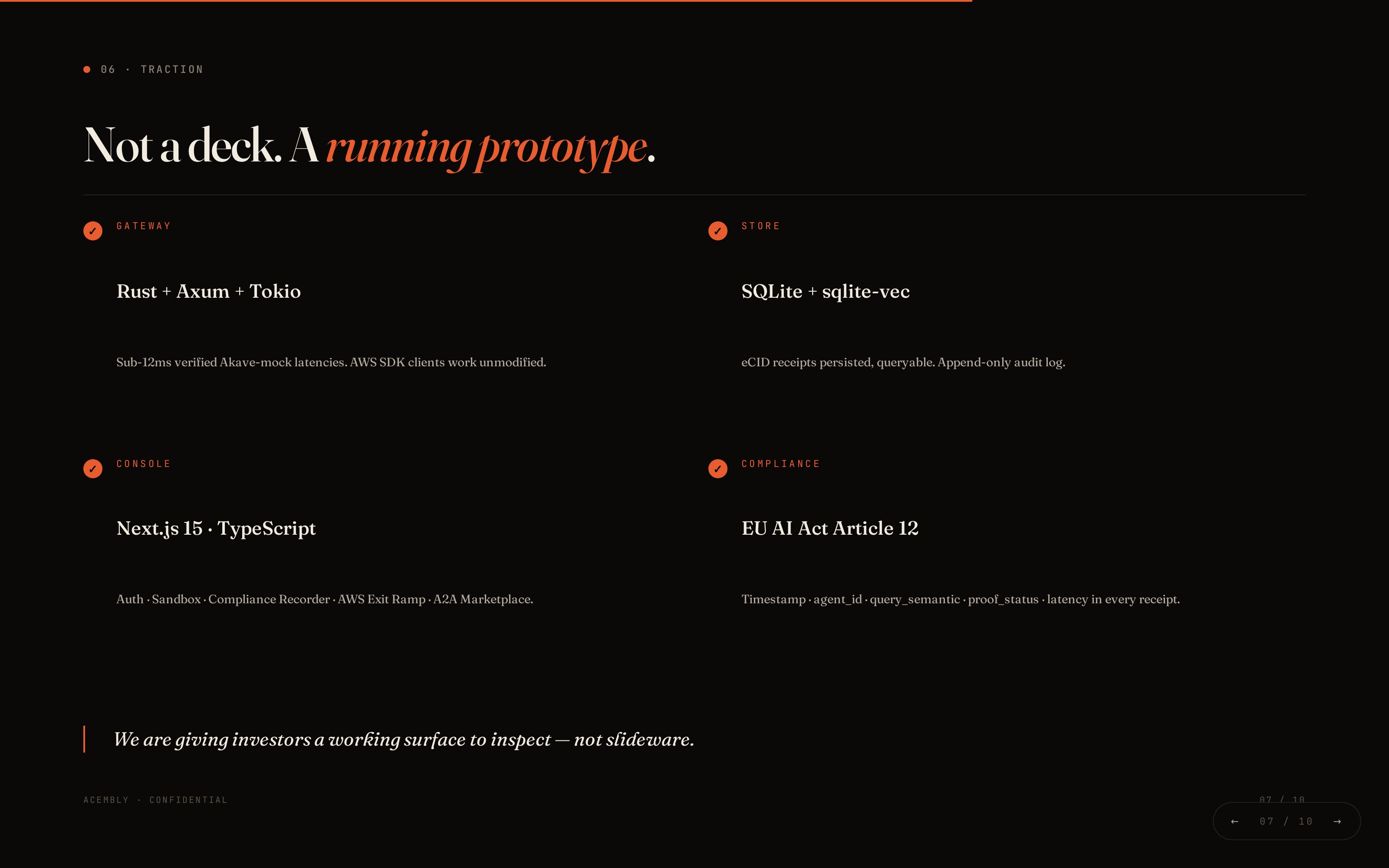
Working prototype shipping today: Rust gateway (Axum + Tokio, sub-12ms latencies), SQLite + sqlite-vec receipt store, full Next.js developer console, EU AI Act Article 12 mapping in every receipt. We are giving investors a working surface to inspect — not slideware.
Team
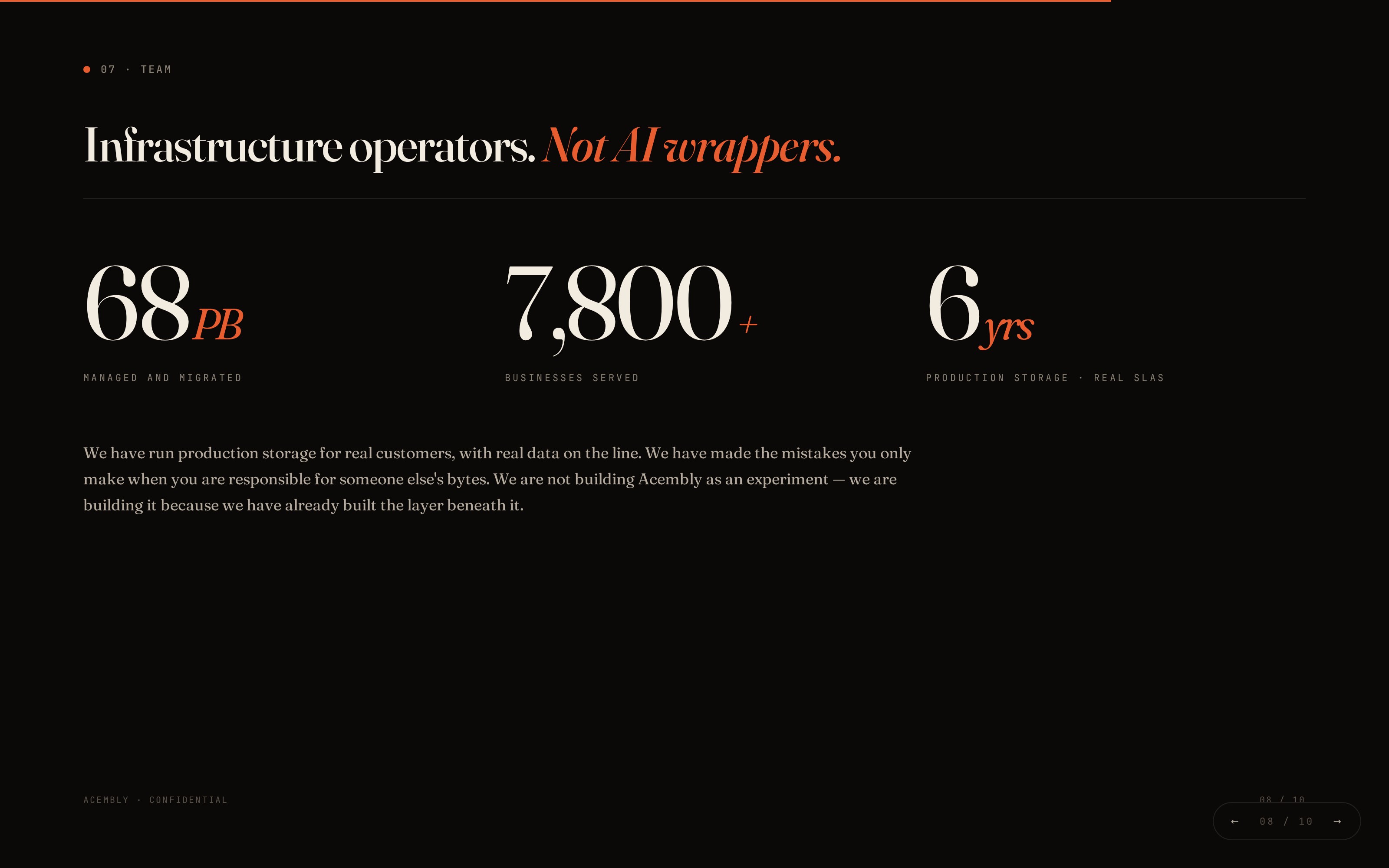
Infrastructure operators, not an AI-wrapper team. We have managed and migrated 68 petabytes of production storage and served 7,800+ businesses over the past 6 years, under real SLAs, for real customers, with real data on the line.
Read the full executive summary →
Round terms
Tiered cap to reward velocity.
The August 2 deadline does not accommodate a 90-day institutional lead process. We are rolling SAFEs with a curated group of operator-angels — and explicitly rewarding speed of decision.
First Close
First $400,000 committed
$6.5M cap
Rolling Close
Remaining $850,000
$8.0M cap
No discount. MFN included. Standard YC post-money SAFE template. First-close investors get an 18.75% better cap in exchange for committing before the $400K threshold.
Use of funds
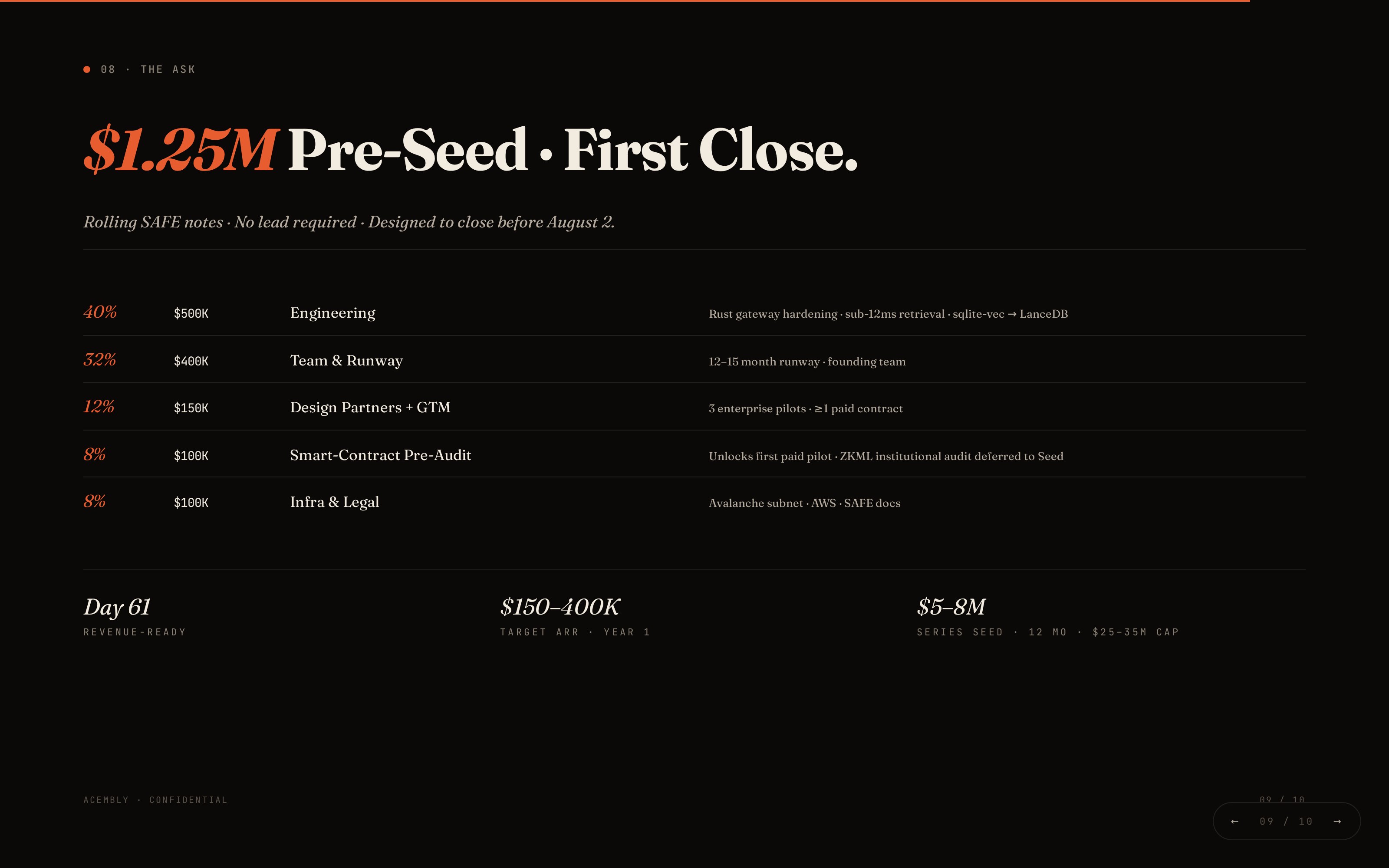
40%
$500K
Engineering
Rust gateway hardening · sub-12ms retrieval · sqlite-vec → LanceDB migration
32%
$400K
Team & Runway
12–15 month runway · founding team
12%
$150K
Design Partners + GTM
3 enterprise pilots discovered · ≥1 paid contract closed
8%
$100K
Smart-Contract Pre-Audit
Unlocks first paid pilot · institutional audit deferred to Seed
8%
$100K
Infra & Legal
Anchoring infrastructure · AWS · SAFE docs
Milestones
| Day 61 (Aug 2, 2026) |
Paid Tier 2 compliance logging launches the morning EU AI Act enforcement beginsRevenue-ready |
| Year 1 ARR target |
$150K–$400KAcross storage and premium verifiability tiers |
| Series Seed |
$5M–$8M at $25M–$35M cap12 months from close · raised against paid revenue |
Process
From verbal yes to wire in 7 days. SAFE delivered within 24 hours of commitment; wire instructions on signature; cap-table entry confirmed within 48 hours of wire. Quarterly investor updates begin the month after wire.
Frequently asked questions
The full diligence list.
40 questions across product, market, team, ask, technical, competitive, regulatory, and risk. Tap any to expand.
Product
1.1 — What does Acembly actually do?
Acembly is the Sovereign Context Gateway — an S3-compatible memory layer that sits between every autonomous AI agent and its storage. Every retrieval gets a tamper-proof cryptographic receipt that doubles as an EU AI Act–compliant audit log. The migration is a single line of code: enterprises change endpoint_url from AWS to Acembly and keep everything else identical.
1.2 — Stripe for AI memory — what does that mean concretely?
Stripe sits between merchants and the card networks, makes payment effortless, takes a small cut, and produces an audit trail that's legally defensible. Acembly sits between AI agents and their storage, makes the data path effortless, takes a small cut per retrieval, and produces a cryptographic receipt that's regulator-defensible. Same shape, different domain.
1.3 — How is this different from Pinecone / Weaviate / LanceDB?
Those are vector databases — they store and query embeddings. Acembly is a memory layer that wraps any storage backend (including those vector DBs) and produces verifiable, compliance-grade receipts on top. We're complementary to them, not competitive. Many of our customers will continue using Pinecone for vector search and route their writes through Acembly for the audit trail.
1.4 — How is this different from observability tools like Helicone or Langfuse?
Observability tools log what an LLM said. Acembly logs and cryptographically proves what an agent remembered — a different and lower-level layer. Observability is about debugging; Acembly is about defensibility. Their logs would not hold up against an EU AI Act audit; ours are designed to.
1.5 — Where is the data actually stored?
The customer chooses. Acembly is storage-agnostic — we can sit in front of AWS S3, Azure Blob, GCS, MinIO, or our preferred sovereign substrate (Akave / Filecoin). The cryptographic receipt is independent of the storage layer; the audit log is portable.
1.6 — How does the eCID receipt actually work?
Every write produces a content-addressed hash (the eCID) plus a cryptographic commitment. That commitment is batched and anchored to a public ledger (Avalanche C-Chain) so the existence and timing of the receipt is provable to any third party — regulator, auditor, insurer — without needing to trust Acembly. The customer never sees a wallet, a token, or any chain mechanics. It's invisible plumbing.
1.7 — Why blockchain at all? Isn't a Merkle tree on S3 enough?
A Merkle tree on S3 proves consistency, but it doesn't prove existence at a point in time without trusting the issuer. Anchoring to a public chain solves the third-party verification problem at a fixed cost (~$0.01 per anchor batch). It's the cheapest known way to make a receipt that holds up in court without us being the trust anchor.
1.8 — What's the actual latency?
Sub-12ms verified end-to-end on writes — that's our SLO. The chain anchor batches asynchronously (every 30 seconds), so the synchronous write path never blocks on a confirmation. The customer experiences AWS-shaped latency.
1.9 — Can I see the prototype?
Yes —
schedule a 20-minute demo for a screen share. The Rust gateway is running, the receipt store is live, and the developer console renders real receipts from real writes.
1.10 — What's mocked in the prototype?
Three things, all narrow boundaries: (1) the EZKL ZKML proof returns a static (real-shaped) hash — we wire in the actual halo2 circuit in Q3; (2) the Avalanche anchor returns a mock C-Chain tx — we replace it with the production contract post-funding; (3) Akave writes hit a local SQLite store with simulated sub-12ms latency — we wire the real Akave SDK in Q3. Everything UI-side, the Rust S3 protocol surface, the receipt schema, and the auth flows are real.
Market
2.1 — How big is this market?
Vector DB + AI storage is tracking to $10.6B–$17B by 2032. But that's the storage layer. The compliance + verifiability layer that sits on top of it is essentially uncreated — and every AI deployment in regulated industries (finance, healthcare, legal, gov) needs it. We sit at the toll booth of that economy.
2.2 — Who's the actual buyer?
CISO and CCO budgets for compliance-grade AI infrastructure. Mid-market and enterprise companies running AI agents in regulated workflows — financial services first (asset managers, banks, insurers), then healthcare (radiology AI, claims processing), then legal (e-discovery, contract review).
2.3 — What's the wedge — who's the first 10 customers?
EU and UK financial-services firms running agentic workflows who have a hard August 2 deadline for AI Act compliance. They will pay $250–$1000/agent/month for a Flight Recorder tier that gets them out of an uninsurable position. We need 10 of these in Year 1; the universe of qualified candidates is ~3,000 firms.
2.4 — Isn't this just a regulatory arbitrage play that disappears in 3 years?
The EU AI Act is the forcing function for the wedge, not the product itself. Once cryptographic audit logs become table-stakes for AI deployment — which the US AI Act, China's measures, and several state-level rules are all pushing toward — Acembly's verifiability becomes a permanent infrastructure layer. Compliance is the door; the marketplace and FinOps tiers are the room.
2.5 — What about AWS just shipping this?
AWS makes its margin on the Read Unit Tax we're eliminating. Building Acembly inside AWS would cannibalize their highest-margin product. The pattern is identical to Stripe vs. the banks — Stripe's product was always technically buildable by the banks, but their economics prevented them from building it. Same here.
2.6 — Is this a $1B company or a $10B company?
If it's only the EU AI Act compliance wedge: $1–3B at IPO. If we successfully extend to A2A commerce settlement layer in years 3–5: $10B+. The exec summary intentionally underwrites only the compliance dollar — the agentic economy upside is structurally there but not in our Year 1 projections.
Team
3.1 — Tell me about the team.
We're infrastructure operators, not an AI-wrapper team. Our last company managed 68 PB of production storage and served 7,800+ businesses over six years, under real SLAs, for real customers, with real data on the line. We are not building Acembly as an experiment — we are building it because we already built the layer beneath it and we know exactly where the next one has to go.
3.2 — Why are you the right team to build this?
Two things: storage scale (which gives us credibility with the buyer) and S3-protocol depth (which gives us the right wedge). Most AI infra teams have never operated production storage under SLA — they're learning that part in real-time, and it shows in their products. We start from the operational fluency most of this category lacks.
3.3 — Who else is on the team / what are you hiring?
We're four engineers, all from the prior infrastructure operation. Post-funding the first two hires are: (1) a smart-contract / cryptography engineer to finalize the EZKL circuit and ship the anchoring contract, and (2) a design-partner success lead to run the first 3 enterprise pilots. Sales / GTM hire comes at Series Seed.
The Ask
4.1 — How are you structuring the round?
$1.25M pre-seed on SAFE notes. Tiered cap to reward speed: first $400K committed at a $6.5M cap, remaining $850K at $8M cap. No discount, MFN included. Closing June 30.
4.2 — Why a tiered cap instead of a flat cap?
Velocity. The deadline matters — we need to deploy the production gateway July 1 to ship paid compliance logging on August 2 when EU AI Act enforcement begins. The tiered cap explicitly rewards investors who decide fast and signals that we're not waiting on consensus.
4.3 — Why a party round and not a lead?
The August 2 deadline doesn't accommodate a 90-day lead-investor process. We're rolling SAFEs with a curated group of operator-angels who know infrastructure — that lets us close in 37 days against the regulatory window. We expect to bring on an institutional lead at the $5–8M Series Seed in 12 months on the back of paid revenue.
4.4 — What does $1.25M buy?
12–15 months of runway for a 4-person engineering team, a smart-contract pre-audit ($100K), 3 enterprise design partner pilots, and the infrastructure to ship paid Tier 2 compliance logging by August 2. We hit Day 61 revenue-ready — Day 61 lands on August 2. Series Seed in 12 months at $5–8M against paid revenue.
4.5 — What happens if you don't close $1.25M by June 30?
We close $1M and extend by two weeks. The product ships on the same date regardless — the August 2 deadline is fixed and the engineering plan is sized to a $1M floor. The remaining $250K becomes a one-month follow-on. Worst case is we forgo the lowest-priority hires until Series Seed.
Technical
5.1 — Walk me through the architecture.
Rust + Axum + Tokio S3 proxy on the front, SQLite + sqlite-vec append-only receipt store in the middle, Akave / Avalanche C-Chain for sovereign anchoring on the back. Schedule a demo for the full screen-share architecture deep-dive.
5.2 — Is the Rust gateway production-ready?
It's prototype-grade today — sub-12ms verified on the hot path, AWS SDK clients work unmodified, but it lacks the hardening you'd need at scale (rate limiting, multi-tenant isolation, SLO monitoring). That hardening is the 40% Engineering allocation in the round.
5.3 — What about the ZKML / EZKL proof — is that real?
Today it returns a static-shaped proof hash; the real halo2 circuit gets wired in Q3 post-funding. That's a four-engineer-week job — the circuit is well-understood, the EZKL library is open-source and battle-tested, and the cryptography is not where the risk lives in this build.
5.4 — How do you scale the chain anchoring economically?
Batched commitments. Every receipt gets a Merkle-tree commitment locally; we anchor the root of N receipts in one Avalanche tx every 30 seconds. At Avalanche C-Chain gas prices, anchoring 10,000 receipts costs us ~$0.001 per receipt — well inside our gross margin envelope.
5.5 — Why Avalanche over Ethereum / Solana / Filecoin / [other chain]?
C-Chain finality is sub-second and fees are predictable, which matters when you're anchoring on a 30-second cadence. Ethereum is too expensive at scale; Solana's finality is faster but less institutional-friendly for the audit narrative; Filecoin is where the storage sits, not where the anchor lives. We're using each chain for what it's best at.
5.6 — What's your moat once the cryptography is commoditized?
Three things. First, the data network effect — every receipt anchored to our identity makes our audit log more valuable to the next customer. Second, the regulatory relationships — once you become the de-facto Article 12 record-keeper, switching costs are catastrophic for the buyer. Third, the A2A marketplace — once agents settle context purchases through us, we become payment rails for the agentic economy. The cryptography is implementation; the network is the moat.
Competitive
6.1 — Who are the competitors?
Direct: no incumbent owns the verifiable memory category — that's the opportunity. Adjacent: Pinecone (vector DB), Helicone (LLM observability), Vanta/Drata (SOC2 compliance), Stripe Atlas (compliance-as-a-service). None of them solve the "tamper-proof receipt per AI memory operation" problem. Two stealth crypto-adjacent teams have shipped early ZKML proofs but neither has a storage-compatible wedge.
6.2 — What stops Pinecone from adding cryptographic receipts to their existing product?
Pinecone is a vector database — their value is fast cosine search at scale. Adding tamper-proof receipts requires (1) chain expertise they don't have and (2) S3-compatibility they don't offer. It would require rebuilding their core product. Pinecone is a customer, not a competitor.
6.3 — What about Filecoin / Storj / Sia building this themselves?
They could try, but their wedge is decentralized storage economics, not AI compliance. They have no S3 compatibility story, no enterprise sales motion, and no regulatory narrative. We're far more likely to partner with them than compete with them — Akave (built on Filecoin) is already in our anchor stack.
Regulatory
7.1 — Is the EU AI Act August 2 date real and binding?
Yes. Article 12 obligations on high-risk AI systems begin enforcement on August 2, 2026. Companies deploying agentic workflows in regulated industries (finance, healthcare, public services, employment, law enforcement) must produce automated record-keeping that meets specific traceability standards. Without that, the system cannot legally be deployed in the EU.
7.2 — What about US / China / other regulatory exposure?
US: the federal AI executive order and state-level rules (Colorado, California) are moving in the same direction — automated logging, audit trail, demonstrable provenance. China: AIGC measures already require traceable training data records. The EU is first; the rest follow within 18–24 months. We are positioning Acembly to be the default record-keeper across all of them.
7.3 — Are you HIPAA / SOC2 / ISO certified?
Not yet. Pre-funding the cost of those certifications is the wrong sequencing — we land design partners on letter-of-intent terms first, then run the certification track in parallel with Series Seed prep. The Smart-Contract Pre-Audit ($100K in our allocation) is the prerequisite work for the institutional ZKML audit at Series Seed, which is itself the gate to enterprise procurement.
Risk & Objections
8.1 — What's the single biggest risk?
Adoption velocity. The technical risk is low — every component is implementation, not invention. The market risk is moderate but timing-favored by the August 2 deadline. The real risk is whether enterprise procurement cycles compress fast enough to land 3 paid pilots before Series Seed. We mitigate by underwriting only $150–$400K ARR in Year 1 — a defensible target even at slow enterprise pace.
8.2 — Why now and not 12 months ago — or 12 months from now?
12 months ago: the agentic workflow market was still mostly research demos, the EU AI Act wasn't enforceable, and the buyer didn't yet exist. 12 months from now: an incumbent will have started to claim this category, and we lose the first-mover advantage on regulatory positioning. The window is May–August 2026, and we're starting it.
8.3 — Why isn't this just a feature inside Datadog / Splunk / Snowflake?
Logging into Datadog is observability — what happened. Acembly is verifiability — that what happened can be cryptographically proven to a third party. Those are different products with different buyers (CTO vs. CCO) and different price points. Datadog can wrap our API as a partner; they cannot become us without an architectural rebuild.
8.4 — What if you can't ship by August 2?
We have a 21-day buffer between our Day 61 ship date and any reasonable AI Act enforcement grace period. The product can ship as a public beta on August 2 with paid Tier 2 logging gated behind a design-partner waitlist — that protects revenue even if a single component (the EZKL circuit, the smart contract audit) slips by 2 weeks. The narrative survives a one-week slip; it doesn't survive missing the date entirely, which is why we're closing the round on June 30 instead of mid-July.
See it running
Not slideware. A running prototype.
20 minutes on a screen share. We open the developer console, type a thought into the sandbox, watch the pipeline execute end-to-end, and inspect a real eCID receipt in the Compliance Flight Recorder. You'll see Rust gateway latencies, the SQLite receipt store, the EU AI Act Article 12 column mapping, and the AWS Exit Ramp diff that shows the one-line migration.
What we'll cover in 20 minutes
- Live submission of an agent thought through the sandbox pipeline
- End-to-end inspection of an eCID receipt — hash, agent ID, query semantic, proof status, Avalanche anchor tx
- The Compliance Flight Recorder with EU AI Act Article 12 column mapping
- The AWS Exit Ramp — the one-line code change in context, with live bucket scan
- A2A Marketplace surface — wallet balances, public context toggles
- Q&A — typically 8–10 minutes